
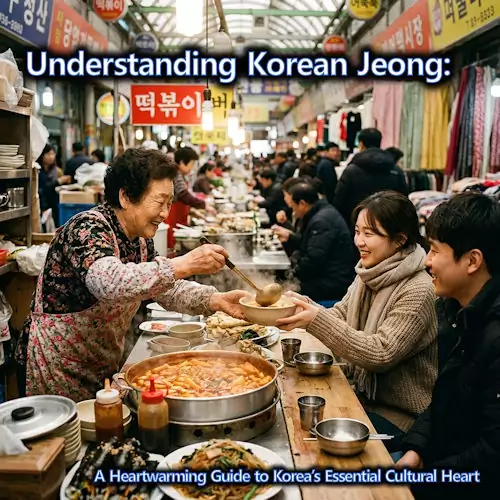
Have you ever wondered why a stranger in Seoul might suddenly offer you an umbrella or why a restaurant owner gives you extra food for free? This isn’t just random kindness; it is the pulse of a nation. Let’s dive into the invisible thread that binds millions of hearts together.
1. What is the True Meaning of This Bond?
- Many visitors find themselves confused by the intense hospitality in Korea. It goes beyond simple politeness or Western friendship. Understanding Korean Jeong is the first step to decoding the social DNA of the peninsula.
- At its core, the concept of Jeong represents a sticky, deep-seated attachment that develops through shared time and space.
- As a cultural researcher and digital content creator living in Seoul, I have observed how this sentiment functions as a vital social lubricant.
- My years of field study in local traditional markets confirm that this bond is more about “us” than “me.”
- It is a silent contract of mutual care that defines every meaningful interaction.
- Interestingly, while the cultural sentiment is spelled ‘Jeong,’ it is often confused with the common Korean surname Jung, though they carry entirely different meanings in the Korean language.
2. Roots in the Collective History of Korea
- To truly grasp this feeling, we must look at the past. Historically, Korea was a tight-knit agricultural society where survival depended on cooperation.
- This history created a “we-ism” culture that still thrives in modern skyscrapers. Exploring the concept of Jeong reveals how ancient village values transformed into contemporary social support systems.

3. Identifying the Five Everyday Moments of Connection
- You will see this phenomenon in the smallest gestures.
- It appears when a grandmother at a market gives you an extra piece of fruit without asking for money.
- In these moments, understanding Korean Jeong helps you realize that the gift isn’t about the fruit; it is about the human connection. It is an emotional investment in a fellow person.
4. The Art of “Service” in Modern Businesses
- In Korean restaurants, you might receive a dish you didn’t order. This is called “service,” a manifestation of hospitality.
- While it seems like a marketing trick, it is deeply rooted in the concept of Jeong.
- The owner wants you to feel like a guest in their home, not just a customer in a store.
- I often find that these small, free dishes taste the best because they come with a warm smile.
5. Sharing Food and the Philosophy of Banchan

- Eating together is the ultimate way of bonding.
- When you share side dishes, or Banchan, you are participating in a communal ritual.
- This practice strengthens the group’s unity.
- Understanding Korean Jeong in a dining setting means accepting that your plate belongs to everyone at the table, fostering a sense of shared destiny.
- In my experience, the best conversations happen over a shared pot of stew.
6. Unexpected Kindness Between Strangers
- You might see people helping a lost traveler or even a person who has had too much to drink.
- This willingness to help those in need is a practical side of the concept of Jeong.
- If you are curious about specific social behaviors, you can read more about why Koreans help drunk strangers as a unique cultural phenomenon.
7. Workplace Harmony and the Hoesik Culture
- The office is another place where these ties are built.
- Coworkers often spend long hours together and share drinks during Hoesik.
- Even in a competitive environment, the concept of Jeong ensures that colleagues look out for one another.
- It creates a family-like atmosphere that makes even the most stressful deadlines feel manageable through teamwork and mutual support.
8. Neighborhood Warmth and the Tradition of Tteok
- Moving into a new home traditionally involved sharing rice cakes, or Tteok, with neighbors.
- While the pace of life has changed, the underlying spirit remains.
- Understanding Korean Jeong in a neighborhood context means looking beyond your own door.
- It is about recognizing that your neighbors are part of your extended social ecosystem and well-being.
9. Practical Tips for Foreigners to Build Bonds
- If you want to experience this, start small.
- Bring a modest gift when visiting a house. Always accept “service” food with a genuine smile and a respectful bow.
- Using the concept of Jeong as your guide, focus on sincerity rather than the monetary value of a gift.
- A small handwritten note often carries more weight than an expensive bottle of wine.

9.1. Receiving with Both Hands
- Always use both hands when giving or receiving.
- This shows that your heart is fully present in the exchange.
- It is a fundamental sign of respect that I always practice in my daily life.
9.2. Returning the Favor Later
- You don’t need to pay someone back immediately. This bond is a long-term journey.
- Wait for the right moment to return the kindness, keeping the cycle of warmth moving forward.
10. Overcoming Cultural Misunderstandings
- Sometimes, this closeness can feel overwhelming or intrusive to Westerners. However, the concept of Jeong is rarely meant to be a burden. It is an expression of concern.
- By understanding Korean Jeong, you can shift your perspective from feeling “monitored” to feeling “cared for.”
- This mental shift is the key to a happy life in Korea.
11. Expanding the Connection Beyond Language
- Language is often a barrier, but emotions are universal.
- You don’t need perfect grammar to show someone you care. Simple eye contact and a warm “Gamsahamnida” go a long way.
- The concept of Jeong proves that the most powerful communications happen in the silence between words, where two souls simply acknowledge each other’s humanity.
12. Conclusion: A Heart That Never Grows Cold
Ultimately, understanding Korean Jeong is about finding home in a foreign land. It is the invisible glue that makes a crowded city feel like a small village. As you walk through the streets of Korea, open your heart to these tiny sparks of connection. You will find that the world is much warmer than you ever imagined.