
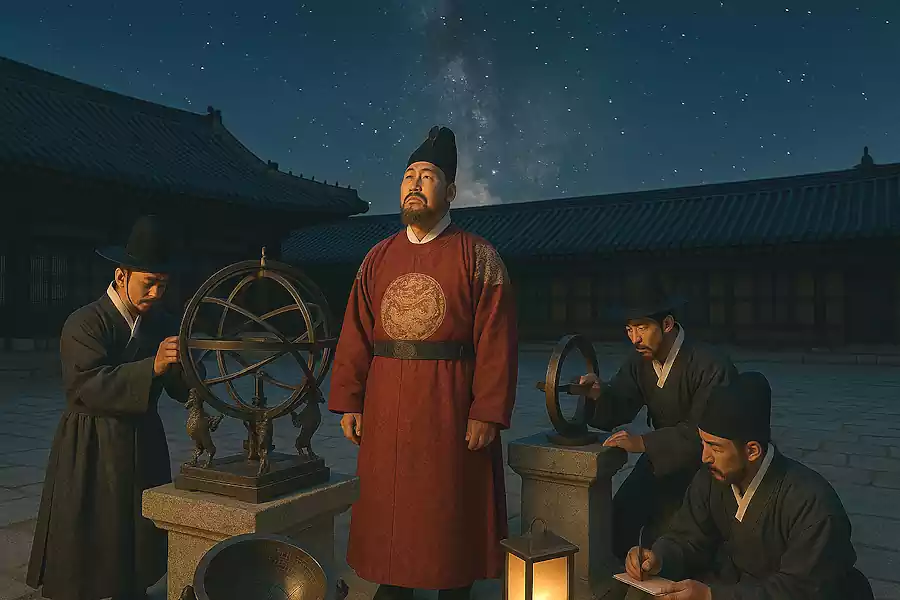
The Skywatcher King Sejong, the fourth monarch of Korea’s Joseon Dynasty, is renowned not only for his leadership but also for his scientific pursuits – particularly in astronomy. He believed that understanding celestial movements could reinforce royal authority and benefit the lives of his people. Through careful observation of the sun, stars, and planets, he aimed to create a more accurate calendar and improve farming cycles. This article explores his methods and the innovative astronomical instruments developed during his reign.
1. Why The Skywatcher King Turned to Astronomy

The Skywatcher King Sejong’s interest in astronomy was not simply academic. In East Asian traditions, celestial phenomena were closely linked to the legitimacy of the ruler and the harmony of the state. Instead of relying solely on Chinese calendrical systems, he sought to create a calendar that better suited Korea’s latitude and seasonal patterns.
To achieve this, he assembled a team of astronomers and engineers, tasking them with the development of new astronomical instruments and observational techniques. His era witnessed a fusion of practicality and scientific innovation, marking one of the greatest scientific revolutions in Korean history.
2. Astronomical Instruments Developed During His Reign
The Skywatcher King installed various astronomical instruments both inside and outside the royal palace to enable accurate sky observations.
(1) Ganuidae (Celestial Observatory Platform)
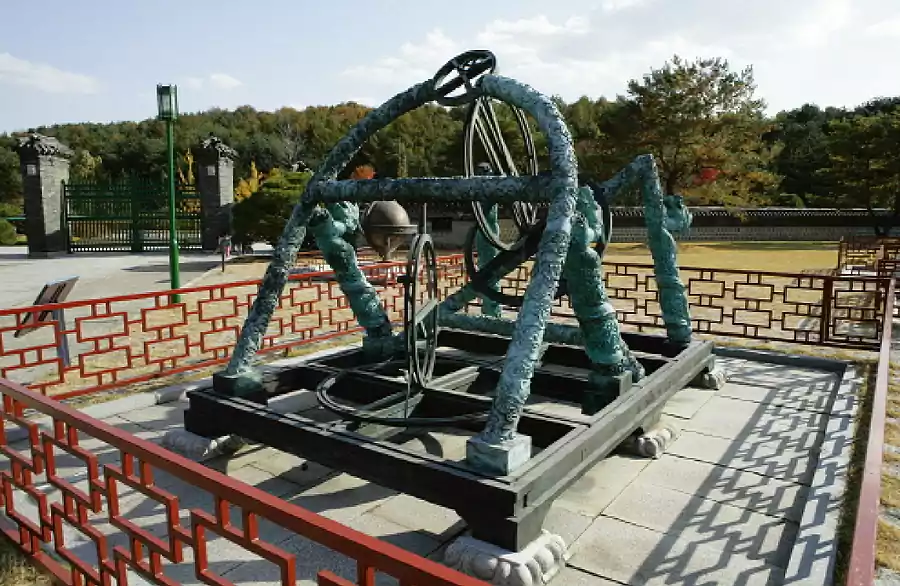
Built in the 14th year of his reign near Gyeonghoeru Pavilion in Gyeongbokgung Palace, this massive platform served as the base for observing the positions of the sun and stars to support calendar calculations.
(2) Gyu-pyo (Shadow Gnomon)

A vertical stick used to measure shadows cast by the sun, which helped determine seasons and time. It played a vital role in agricultural scheduling.
(3) Angbu Ilgu and Hyeonju Ilgu (Public Sundials)
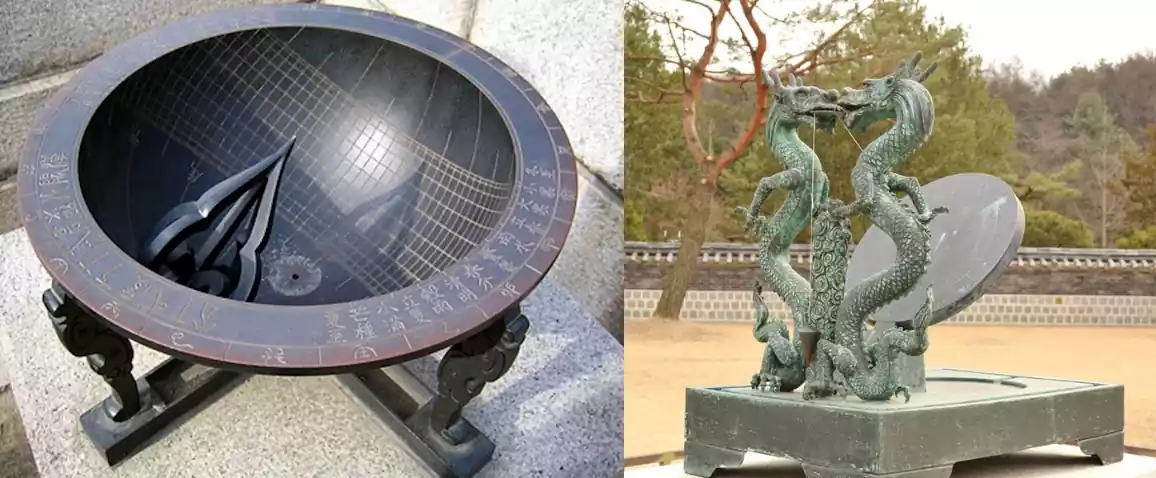
These were Korea’s first public sundials, allowing commoners to tell the time by observing the sun’s shadow – an early form of public timekeeping and an example of practical astronomical instruments made for the people.
(4) Ilseong Jeongsiui (Celestial Time-Determining Instrument)
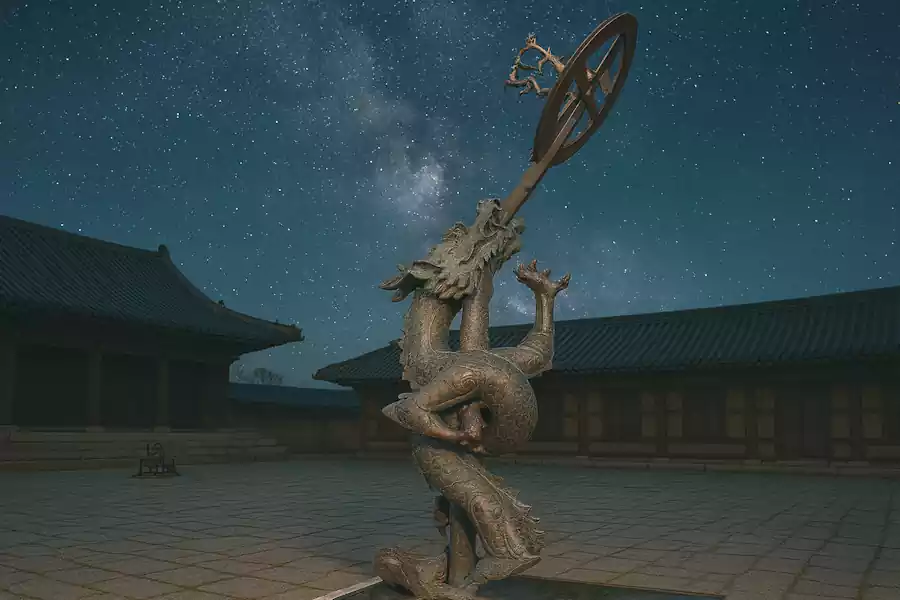
An advanced device capable of measuring time by using the sun’s height during the day and stellar movement at night. This was one of the most sophisticated astronomical instruments of the time.
These astronomical instruments reflect The Skywatcher King Sejong’s belief in science as a tool for public good, bridging royal scholarship and everyday life.
3. Methods of Sky Observation in the Sejong Era

The Skywatcher King and his astronomers followed systematic procedures in their observations.
(1) Measuring Star Angles Based on the Celestial Pole
Instruments were aligned with the North Star (Polaris), and the angles of stars’ movements were recorded at regular intervals. This method closely resembles today’s equatorial coordinate system in modern astronomy.
(2) Measuring the Sun’s Meridian Altitude
By observing the sun’s highest point in the sky (solar noon), astronomers could estimate geographic latitude and determine seasonal changes – information essential for creating accurate calendars.
(3) Measuring Time by Day and Night
The Skywatcher King Sejong believed that “starlight at night is as important as sunlight during the day.” This philosophy led to the creation of Ilseong Jeongsiui, a device that divided the 24 hours of the day using both sunlight and starlight. This innovation helped advance time measurement in Joseon Korea to a new scientific level through the use of astronomical instruments.
4. The Achievements of Sejong’s Astronomy

Sejong’s contributions extended beyond observation; he laid the groundwork for a new scientific understanding of the cosmos.
His most notable achievement was the Chiljeongsan (Seven Celestial Calculations) – an astronomical text that calculated the movements of the sun, moon, Mercury, Venus, Mars, Jupiter, and Saturn. It marked the first Korean-developed calendrical system based on real-time observations using advanced astronomical instruments.
In 1437, The Skywatcher King Sejong’s astronomers recorded a rare stellar explosion known as a “guest star” (nova). This record remains one of the most precise astronomical observations in East Asian history, demonstrating that Korean astronomy was moving from tradition to empirical science.
5. The Modern Meaning of Sejong’s Astronomy
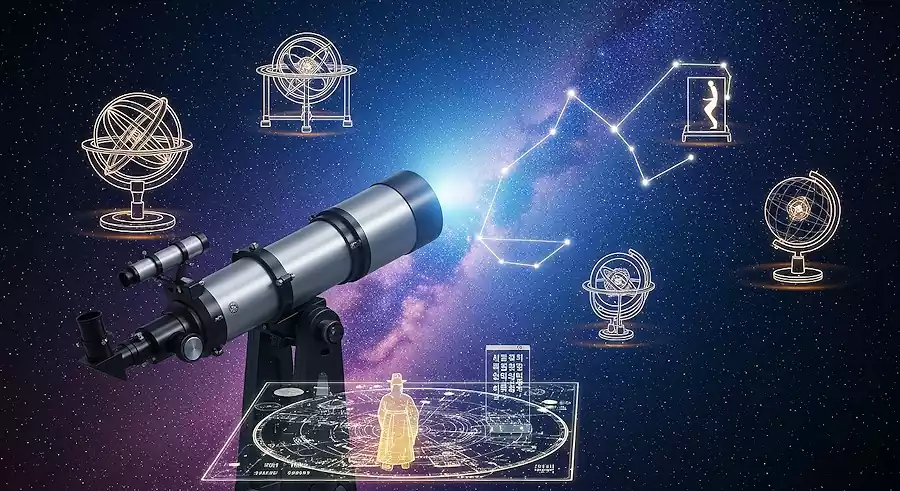
The legacy of The Skywatcher King Sejong is a testament to what human observation and reasoning can accomplish. Without telescopes or modern technology, he measured celestial movements with remarkable accuracy using innovative astronomical instruments of his time. His efforts were driven not by personal gain but by a desire to align the natural order with the lives of his people.
His work represents one of the most human-centered scientific pursuits in history – a pursuit that still inspires modern scientists today.
※ Discover Korea’s ancient heating marvel, Ondol. This ingenious underfloor system, passed down for millennia, circulates heat through floor channels for whole-body warmth in traditional hanok homes.
6. Conclusion
The Skywatcher King Sejong’s gaze toward the heavens was not just a royal hobby – it was a profound scientific mission. His methods, insights, and development of precise astronomical instruments helped define a uniquely Korean approach to astronomy. More importantly, they showed how science, when guided by empathy and vision, can serve humanity in the most meaningful ways.
※ Explore Korea’s Cultural Heritage Agency site for deeper insights.
Visit This site to uncover Ondol’s Bronze Age origins, structural details, and UNESCO recognition